Music & The Performing Arts
[HENDERSON, George] Blind Joe Death's America. John Fahey, the Blues, and Writing White Discontent (Softcover)
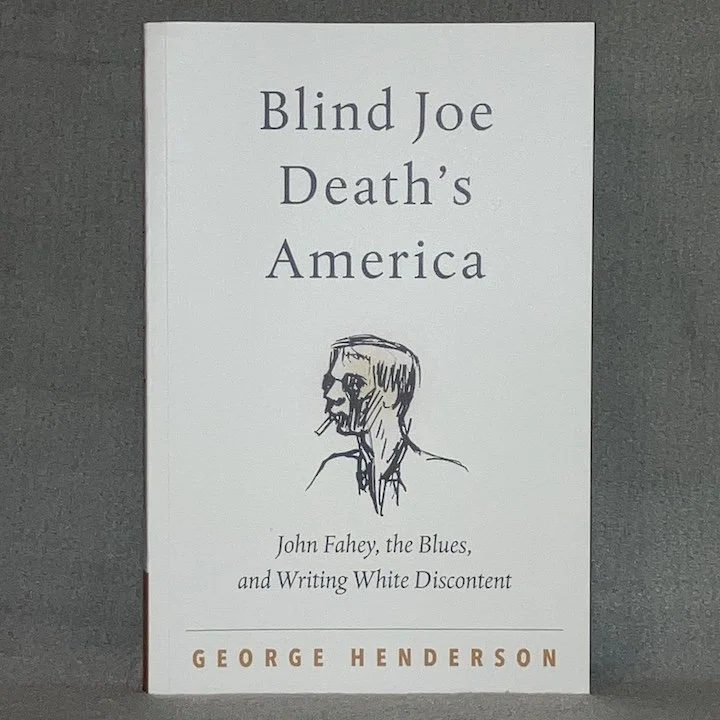
[HENDERSON, George] Blind Joe Death's America. John Fahey, the Blues, and Writing White Discontent (Softcover)
Chapel Hill: University of North Carolina Press, 2021. Softcover. Octavo. 222pp. Light curl to front cover. A very good or better copy.
For over sixty years, American guitarist John Fahey (1939–2001) has been a storied figure, first within the folk and blues revival of the long 1960s, later for fans of alternative music. Mythologizing himself as Blind Joe Death, Fahey crudely parodied white middle-class fascination with African American blues, including his own. In this book, George Henderson mines Fahey’s parallel careers as essayist, notorious liner note stylist, musicologist, and fabulist for the first time. These vocations, inspired originally by Cold War educators' injunction to creatively express rather than suppress feelings, took utterly idiosyncratic and prescient turns.
Fahey voraciously consumed ideas: in the classroom, the counterculture, the civil rights struggle, the new left; through his study of philosophy, folklore, African American blues; and through his experience with psychoanalysis and southern paternalism. From these, he produced a profoundly and unexpectedly refracted vision of America. To read Fahey is to vicariously experience devastating critical energies and self-soothing uncertainty, passions emerging from a singular location—the place where lone, white rebel sentiment must regard the rebellion of others. Henderson shows the nuance, contradictions, and sometimes brilliance of Fahey’s words that, though they were never sung to a tune, accompanied his music.